
Introduction
Have you ever wondered how some AI systems seem to think ahead, make decisions, and complete tasks with little human input? As AI continues to evolve, many people are curious about what’s powering these smarter, more independent systems and how they can be used in real-world applications. That’s where Agentic AI Development is starting to capture attention.
In this guide, you’ll learn what Agentic AI Development is, how it works, and why it’s becoming such an important part of the future of technology. Whether you’re a developer, business owner, or simply interested in AI, this article will break down the concepts in a simple and practical way so you can better understand its potential and opportunities.
What Is Agentic AI Development?
Agentic AI Development is the process of creating AI systems that can plan, reason, make decisions, and execute tasks with minimal human intervention. Unlike conventional AI models that simply respond to prompts, agentic AI systems can pursue goals, adapt to changing situations, and take action across multiple steps.
These intelligent AI agents combine reasoning, memory, planning, and tool usage to solve complex problems. As businesses demand more advanced automation, AI agent development has become a key area of innovation for companies seeking scalable AI automation and operational efficiency.
Core Characteristics of AI Agents
AI agents are designed to act with purpose rather than simply react to instructions. They can understand objectives, break tasks into smaller actions, evaluate outcomes, and adjust their behavior when circumstances change.
Most autonomous AI agents share several traits including goal-oriented behavior, memory retention, environmental awareness, and autonomous decision-making. These capabilities allow them to perform intelligent task automation across different business functions.
How Agentic AI Works
Understanding how agentic AI works begins with recognizing its ability to combine reasoning with action. An agent receives a goal, analyzes available information, develops a plan, and then executes tasks while continuously evaluating results.
Many modern agentic AI frameworks use large language model agents as the reasoning engine. The system connects those models with tools, databases, APIs, and workflows to achieve autonomous task execution.
Agentic AI vs Traditional AI
Traditional AI systems are generally reactive. They answer questions, classify data, or generate content based on user inputs. Once the task is complete, the process usually ends.
Agentic AI takes a different approach. It can initiate actions, monitor progress, revise strategies, and continue working toward objectives. This shift makes agent-based AI significantly more powerful for complex business operations.
| Feature | Traditional AI | Agentic AI |
| Decision Making | Limited | Autonomous |
| Planning | Minimal | Goal-Based |
| Tool Usage | Rare | Extensive |
| Adaptability | Moderate | High |
| Task Execution | Single-Step | Multi-Step |
Key Components of Agentic AI Development
Successful Agentic AI Development relies on several interconnected components working together. Each element contributes to the agent’s ability to think, plan, and act independently.
When combined effectively, these components create next-generation AI systems capable of handling sophisticated tasks across industries. Understanding these building blocks is essential for designing reliable and scalable AI-powered automation solutions.
Autonomous Decision-Making
Autonomous decision-making allows AI agents to evaluate options and choose the most appropriate action. Instead of waiting for human guidance, the system uses available data and predefined objectives to move forward.
This capability supports AI-powered decision making in customer service, logistics, finance, and enterprise AI automation environments.
Goal-Oriented Planning
Planning enables agents to break large objectives into manageable tasks. The AI identifies dependencies, prioritizes actions, and creates execution strategies to reach desired outcomes.
AI planning and execution are among the most important features separating agentic AI from conventional automation systems.
Memory and Context Management
Memory helps agents retain information across interactions and tasks. Rather than treating every request as a new event, the AI can reference previous conversations, actions, and outcomes.
Strong context management improves consistency, personalization, and long-term performance in autonomous workflows.
Tool Usage and API Integration
Modern agents rarely work alone. They interact with databases, software platforms, search systems, and third-party applications through APIs.
AI tool integration expands the capabilities of agents beyond language generation. They can retrieve information, update records, generate reports, and automate business process automation workflows.
Multi-Agent Collaboration
Some of the most advanced systems use multiple agents working together. One agent may gather information while another performs analysis and a third manages execution.
Multi-agent systems improve efficiency and specialization. They also enable more complex AI orchestration across enterprise environments.
How Agentic AI Systems Are Built
Building agentic AI systems requires careful planning, architecture design, and ongoing optimization. Developers must balance intelligence, reliability, security, and scalability throughout the AI agent lifecycle.
Although technologies continue to evolve rapidly, most successful projects follow a structured development process that supports long-term performance and growth.
Data Collection and Processing
Every intelligent system depends on quality data. Developers collect information from databases, documents, applications, sensors, and user interactions to train and support AI agents.
Clean, structured data improves reasoning accuracy and enables more effective AI workflow management.
Choosing Foundation Models
Foundation models serve as the reasoning engine behind many AI agents. Organizations evaluate factors such as performance, cost, scalability, and domain expertise before selecting a model.
Large language models often provide the flexibility needed for advanced AI reasoning models and autonomous workflows.
Agent Architecture Design
AI agent architecture determines how agents think, communicate, and perform tasks. Developers define memory systems, planning mechanisms, tool integrations, and communication protocols.
A strong architecture supports scalable AI automation while maintaining reliability and adaptability.
Testing and Evaluation
Testing helps identify weaknesses before deployment. Teams evaluate reasoning quality, task completion rates, response accuracy, and safety controls.
Regular evaluation ensures custom AI agents continue meeting business objectives while reducing operational risks.
Deployment and Monitoring
After testing, agents move into production environments. Continuous monitoring tracks performance, identifies errors, and measures business outcomes.
Successful AI agent deployment requires ongoing maintenance and optimization as organizational needs evolve.
Popular Frameworks for Agentic AI Development
The growing popularity of Agentic AI Development has led to the emergence of powerful frameworks that simplify implementation. These platforms provide tools for creating, managing, and scaling autonomous AI systems.
Choosing the right framework depends on project goals, technical requirements, and integration needs. Each platform offers unique advantages for different use cases.
LangChain
LangChain is one of the most widely adopted frameworks for AI workflow automation. It provides components for memory management, tool integration, and workflow orchestration.
Developers often use LangChain when building sophisticated agentic AI applications that require flexible reasoning and execution capabilities.
CrewAI
CrewAI focuses on collaborative AI agents working together as specialized teams. Each agent performs a specific role while contributing to a larger objective.
This framework is particularly useful for multi-agent collaboration and enterprise workflow automation.
AutoGen
AutoGen enables conversations between multiple AI agents. The framework allows agents to collaborate, debate solutions, and solve complex tasks autonomously.
Organizations exploring multi-agent systems in AI development often choose AutoGen for its flexibility and scalability.
Semantic Kernel
Developed by Microsoft, Semantic Kernel combines AI capabilities with traditional software development practices. It supports memory management, planning, and enterprise integrations.
Many enterprise AI solutions use Semantic Kernel because it fits well within existing technology ecosystems.
OpenAI Agents SDK
The OpenAI Agents SDK provides tools for creating production-ready AI agents. It simplifies workflow management, tool integration, and agent orchestration.
For teams seeking modern AI implementation strategies, this framework offers a practical foundation for building intelligent automation systems.
Real-World Applications of Agentic AI
The rise of Agentic AI Development is transforming how organizations operate across industries. Instead of automating isolated tasks, agentic AI systems can manage entire workflows, coordinate actions, and continuously improve outcomes.
From customer service to financial analysis, businesses are discovering new ways to use autonomous AI systems to reduce manual work and increase productivity. These real-world agentic AI use cases demonstrate why the technology is gaining momentum worldwide.
Customer Support Automation
Customer support teams often handle thousands of repetitive requests every day. Agentic AI systems can understand customer intent, access relevant information, and resolve issues without human intervention.
Unlike traditional chatbots, enterprise AI agents can manage multi-step conversations, update records, escalate cases when necessary, and follow up automatically. This creates faster response times and better customer experiences.
Software Development Assistance
AI agents are becoming valuable partners in AI software development. They can write code, review pull requests, identify bugs, generate documentation, and even suggest architectural improvements.
Many organizations now use AI agents in software development to accelerate project delivery and improve code quality. Developers remain in control while agents handle routine and time-consuming tasks.
Healthcare and Research
Healthcare organizations generate enormous amounts of data. Intelligent AI agents can analyze medical records, summarize research papers, identify patterns, and assist with administrative workflows.
Researchers also use autonomous AI agents to explore scientific literature, organize findings, and support data-driven decision-making. This allows experts to focus more on innovation and patient care.
Financial Analysis
Financial institutions rely on accurate information and fast decisions. Agentic AI applications can monitor markets, analyze reports, detect anomalies, and generate investment insights.
These systems help improve AI-driven operational efficiency by processing large datasets faster than traditional methods. They also support risk management and strategic planning activities.
Marketing and Content Creation
Marketing teams use AI-powered automation to streamline campaign management, audience analysis, and content production. Agents can collect data, evaluate performance metrics, and recommend optimization strategies.
Content creators benefit from intelligent automation that assists with research, planning, publishing, and performance tracking. This enables teams to produce more high-quality content with fewer resources.
Benefits of Agentic AI Development
Organizations investing in Agentic AI Development often see significant improvements in efficiency, scalability, and productivity. Unlike traditional automation tools, agentic systems can adapt to changing conditions and continue working toward business goals.
One major advantage is autonomous task execution. Agents can handle complex workflows that would normally require multiple employees or software systems. This reduces operational costs while increasing output.
Another benefit is enhanced decision-making. AI planning and reasoning capabilities allow agents to evaluate options and choose appropriate actions in real time. Businesses gain faster responses and improved consistency across operations.
Agentic AI also supports digital workforce automation. Teams can delegate repetitive processes to AI agents while focusing on higher-value activities such as innovation, strategy, and customer engagement.
Challenges and Risks of Agentic AI
Although the future of agentic AI looks promising, organizations must address several challenges before large-scale deployment. Effective governance, security, and reliability remain essential for success.
As AI agents gain more autonomy, businesses need clear policies and safeguards to ensure responsible operation. Understanding these risks helps organizations create sustainable AI implementation strategies.
Security Concerns
Autonomous agents often interact with multiple systems, applications, and data sources. This expanded access creates potential security vulnerabilities if not managed properly.
Organizations should implement strong authentication controls, access restrictions, monitoring systems, and regular security audits to protect enterprise environments.
Ethical Considerations
AI-powered decision making raises important ethical questions. Businesses must ensure agents operate fairly, transparently, and without unintended bias.
Responsible AI governance helps maintain trust among customers, employees, and stakeholders while supporting long-term adoption.
Hallucinations and Reliability Issues
Even advanced AI reasoning models can generate incorrect information. These hallucinations may lead to poor decisions or inaccurate outputs if left unchecked.
Human oversight, validation mechanisms, and continuous testing help improve reliability and reduce errors in agent-based AI systems.
Data Privacy Challenges
Many AI agents process sensitive information during normal operations. Without proper safeguards, organizations risk exposing confidential data.
Strong encryption, compliance frameworks, and secure data handling practices are critical for protecting customer and business information.
Governance and Compliance
As regulations evolve, businesses must ensure their AI systems comply with industry standards and legal requirements. Governance frameworks establish accountability and operational guidelines.
Effective compliance strategies help organizations scale enterprise AI automation while minimizing regulatory risks.
Best Practices for Successful Agentic AI Development
Building successful agentic AI systems requires more than advanced technology. Organizations must combine technical excellence with strong operational planning and governance.
Start with clearly defined business objectives. AI agents perform best when goals, success metrics, and responsibilities are well understood from the beginning.
Developers should prioritize modular AI agent architecture. Flexible designs make it easier to update components, integrate tools, and scale systems over time.
Continuous monitoring is equally important. Regular evaluation helps identify performance issues, security risks, and opportunities for improvement. Businesses that treat AI as an evolving capability often achieve better long-term results.
Organizations should also maintain human oversight for critical decisions. While autonomous workflows can increase efficiency, human expertise remains valuable for strategic judgment and risk management.
Agentic AI Development Trends for 2026
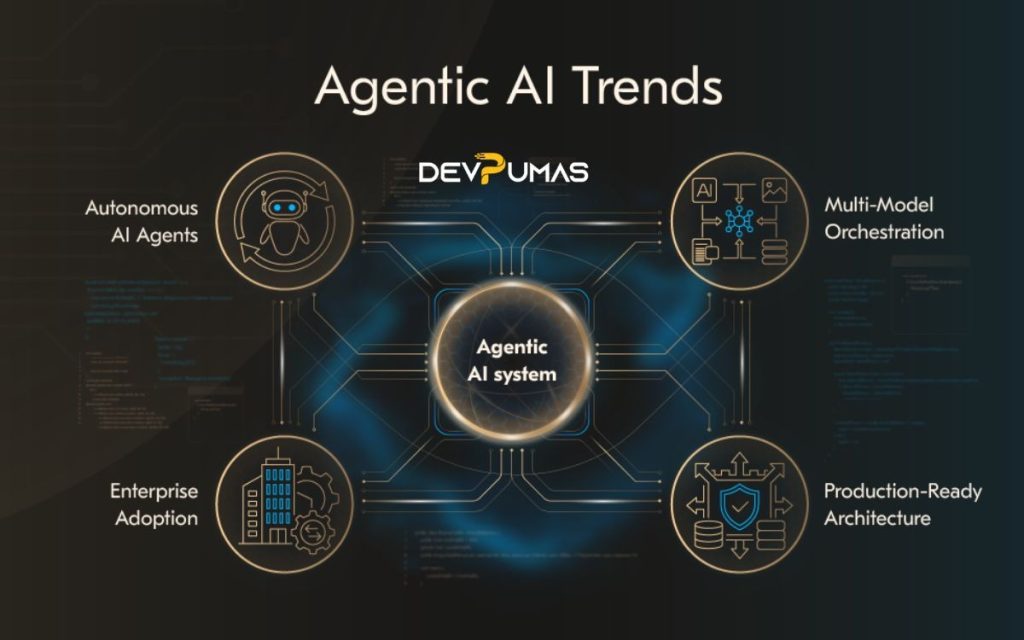
The next wave of innovation is pushing Agentic AI Development beyond simple automation. Emerging technologies are creating smarter, more collaborative systems capable of handling increasingly complex responsibilities.
As adoption accelerates, several trends are shaping the future of agentic AI across industries.
Multi-Agent Ecosystems
Instead of relying on a single AI agent, organizations are deploying teams of specialized agents that collaborate to achieve shared goals.
These multi-agent systems improve efficiency, resilience, and scalability by distributing responsibilities across multiple intelligent entities.
AI Agents in Enterprise Workflows
Enterprise adoption is growing rapidly as organizations seek better ways to automate business operations. AI agents are becoming deeply integrated into daily workflows.
From finance and HR to customer support and supply chain management, agents are driving intelligent automation at scale.
Autonomous Business Operations
The concept of autonomous business operations is moving from theory to reality. AI agents can now manage processes, coordinate resources, and optimize performance with minimal supervision.
This shift is helping organizations improve productivity while reducing operational complexity.
Advanced Reasoning Models
Future AI reasoning models will become more capable of handling ambiguity, long-term planning, and complex decision-making.
These advancements will strengthen autonomous AI systems and enable new categories of AI-driven business solutions that were previously impossible.
Why Businesses Should Invest in Agentic AI Development
Businesses face increasing pressure to improve efficiency while controlling costs. Traditional automation can help, but it often struggles with dynamic and unpredictable environments.
Agentic AI Development offers a more flexible solution. Intelligent agents can adapt, learn, and execute tasks independently, making them valuable assets across departments and industries.
Organizations that invest early gain a competitive advantage through faster decision-making, improved customer experiences, and enhanced operational efficiency. They also position themselves to benefit from future advances in AI-powered automation.
As AI technologies continue to mature, businesses that embrace agentic systems today are more likely to lead tomorrow’s markets.
How DevPumas Can Help with Agentic AI Development
Implementing agentic AI solutions requires technical expertise, strategic planning, and a deep understanding of business objectives. DevPumas helps organizations navigate every stage of the AI agent lifecycle, from concept to deployment.
Whether you need custom AI agents, enterprise AI solutions, workflow automation, or multi-agent systems, DevPumas can design and implement solutions tailored to your specific requirements.
The team focuses on building scalable, secure, and high-performance AI systems that deliver measurable business value. By combining modern frameworks, advanced reasoning capabilities, and industry best practices, DevPumas helps businesses unlock the full potential of agentic AI.
FAQs
What is Agentic AI Development?
Agentic AI Development is the process of building autonomous AI systems that can reason, plan, make decisions, and execute tasks with minimal human involvement.
How does agentic AI differ from traditional AI?
Traditional AI mainly responds to inputs, while agentic AI can pursue goals, use tools, make decisions, and complete multi-step tasks independently.
Which frameworks are best for Agentic AI Development?
Popular frameworks include LangChain, CrewAI, AutoGen, Semantic Kernel, and OpenAI Agents SDK. Each supports different AI agent development needs.
What industries use agentic AI systems?
Healthcare, finance, software development, marketing, customer support, logistics, and enterprise operations are among the leading adopters.
What are the biggest challenges of Agentic AI Development?
Key challenges include security risks, ethical concerns, data privacy issues, hallucinations, governance requirements, and system reliability.
Conclusion
Agentic AI Development is rapidly changing how organizations approach automation, productivity, and innovation. By combining reasoning, planning, memory, and action, agentic AI systems can perform complex tasks that were once impossible for traditional automation tools.
As businesses continue investing in intelligent automation, the demand for autonomous AI agents will only grow. Organizations that understand the technology, adopt best practices, and invest strategically will be better positioned to improve efficiency, create new opportunities, and remain competitive in the AI-driven future.
