
Introduction
If you’ve been thinking about building websites or web applications, you’ve probably come across the term Full Stack Development more than once. It can feel overwhelming at first, especially when you’re trying to understand how front-end and back-end technologies work together to create complete digital experiences.
In this guide, you’ll learn what Full Stack Development really means, why it’s such a valuable skill in today’s tech industry, and what tools and technologies full stack developers use. Whether you’re a beginner exploring a new career path or someone looking to expand your programming skills, this article will give you the insights you need to get started.
What Is Full Stack Development?
Full Stack Development refers to the process of building and maintaining both the client-side and server-side portions of an application. A full stack developer works across the entire application architecture, from designing user interfaces to managing databases and backend infrastructure.
This approach allows developers to understand how different layers of modern web applications connect and communicate. Instead of specializing in only one area, they gain knowledge across multiple technologies and development processes.
Definition of Full Stack Development
At its core, full stack programming involves working with all major components of a web application. These include the front-end interface users see, the back-end logic that processes data, and the databases that store information.
A full stack engineer can build an entire application from start to finish. This versatility makes them valuable in startups, agencies, and enterprise web solutions environments.
Front-End vs Back-End Development
Frontend vs backend development is one of the first concepts beginners encounter. Front-end development focuses on what users interact with directly, including layouts, buttons, menus, and animations.
Back-end development handles business logic, authentication, data processing, and communication with databases. Together, these components create seamless user experiences and functional applications.
Why It’s Called “Full Stack”
The term “stack” refers to the collection of technologies used to build an application. Since developers work across the entire technology stack, they’re called full stack developers.
Think of building a house. The front-end is the exterior and interior design people see. The back-end is the plumbing, electrical wiring, and structural framework that keeps everything working properly.
Components of Full Stack Development
Every successful web application relies on several interconnected components. Understanding these building blocks helps beginners grasp how web technologies work together.
When combined properly, these layers create scalable web applications that deliver fast performance, security, and excellent user experience design.
Front-End Development
Front-end development focuses on user interface development and responsive web design. Developers use HTML5, CSS3, and JavaScript to create attractive and mobile-friendly websites.
Modern frameworks such as React.js, Angular, and Vue.js make it easier to build interactive interfaces while improving performance and maintainability.
Back-End Development
Server-side development powers everything users don’t directly see. This includes user authentication, business logic, application security, and data processing.
Popular backend technologies include Node.js, Express.js, Python, Django, Flask, PHP, Laravel, Java, and Spring Boot. These tools help developers build reliable software solutions.
Database Management
Database development involves storing, organizing, and retrieving application data efficiently. Without databases, applications couldn’t remember user information, products, or transactions.
Popular database management systems include MongoDB, MySQL, and PostgreSQL. Choosing the right database depends on project requirements and scalability goals.
Simple Full Stack Architecture Diagram
Frontend (HTML, CSS, JavaScript)
↓
REST API / GraphQL
↓
Backend (Node.js, Django, Laravel)
↓
Database (MongoDB, MySQL, PostgreSQL)
Essential Skills for Full Stack Developers
Success in this field requires a mix of technical knowledge and soft skills. While tools change over time, core development principles remain valuable throughout a developer’s career.
Building strong full stack developer skills takes patience, practice, and continuous learning.
Programming Languages
Programming languages form the foundation of web development. JavaScript remains one of the most important languages because it works on both the front end and back end.
Many developers also learn Python, PHP, Java, or TypeScript to expand their capabilities and increase career flexibility.
Version Control (Git & GitHub)
Version control helps developers track code changes and collaborate effectively. Git allows teams to manage projects without accidentally overwriting each other’s work.
GitHub provides cloud-based repositories where developers can store code, review changes, and showcase projects to employers.
Database Management
A good full stack developer understands how databases function and how data flows through applications. This knowledge improves performance and helps prevent common development issues.
Learning SQL and NoSQL databases gives developers flexibility when working on different project types.
API Integration
API development enables applications to communicate with external services and systems. Whether connecting payment gateways or social media platforms, APIs play a crucial role in modern software development.
REST API and GraphQL are two widely used approaches for creating and managing application communication.
Problem-Solving Skills
Coding isn’t just about writing syntax. Developers constantly solve problems, troubleshoot bugs, and improve application performance.
Strong analytical thinking helps developers create efficient solutions while reducing development time and maintenance costs.
Popular Technologies Used in Full Stack Development
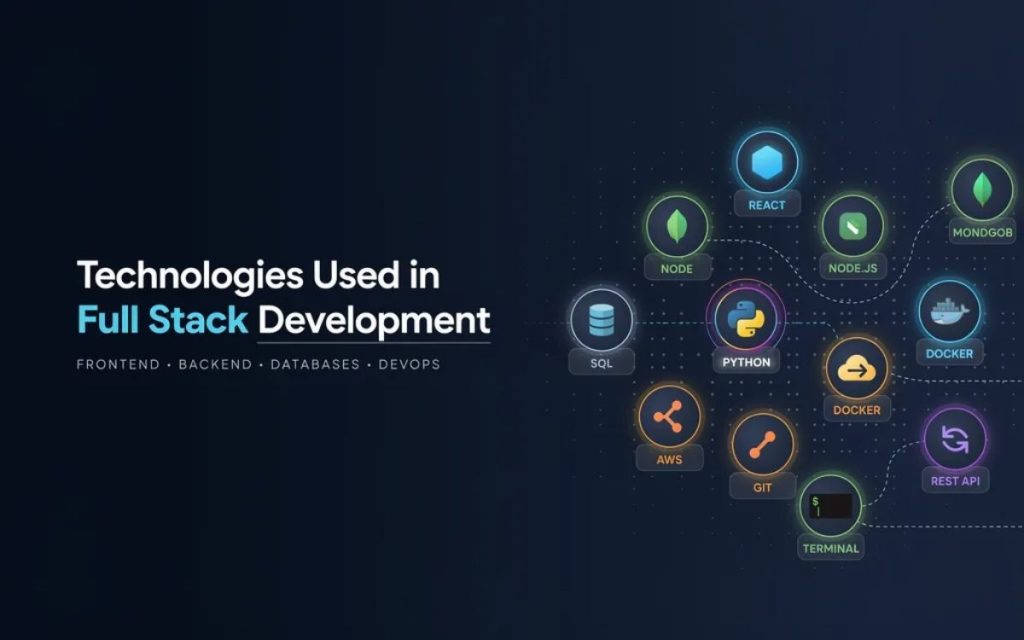
The technology landscape changes rapidly, but some tools remain industry favorites due to their reliability and community support.
Learning the right combination of technologies can significantly accelerate your full stack development career path.
| Layer | Popular Technologies |
| Front-End | HTML5, CSS3, JavaScript, React.js |
| Back-End | Node.js, Django, Laravel, Spring Boot |
| Database | MongoDB, MySQL, PostgreSQL |
| Cloud | AWS, Microsoft Azure |
| DevOps | Docker, Kubernetes |
Front-End Technologies
HTML5 provides structure, CSS3 handles styling, and JavaScript adds interactivity. Together, they form the foundation of client-side development.
Frameworks like React.js, Angular, and Vue.js simplify complex interface development and improve development efficiency.
Back-End Technologies
Back-end frameworks help developers build secure and scalable applications. Node.js and Express.js are popular JavaScript-based solutions for server-side development.
Python frameworks like Django and Flask are known for simplicity and speed. Meanwhile, Laravel and Spring Boot remain popular choices for enterprise applications.
Databases
Databases serve as the backbone of web application architecture. They store user accounts, product information, content, and business data.
MongoDB offers flexibility for modern applications, while MySQL and PostgreSQL provide strong relational database capabilities.
Full Stack Development Roadmap for Beginners
Starting your journey can feel overwhelming because there are many technologies to learn. The good news is that you don’t need to master everything at once. A structured full stack development roadmap makes learning much easier.
The best approach is to build skills layer by layer. As your confidence grows, you’ll understand how different technologies work together in real-world applications.
Step 1 – Learn HTML, CSS, and JavaScript
Every beginner should start with HTML5, CSS3, and JavaScript. These technologies form the foundation of web development and are essential for creating interactive user interfaces.
Spend time building simple websites and practicing responsive web design. Small projects help reinforce concepts much better than passive learning.
Step 2 – Master Front-End Frameworks
Once you’re comfortable with the basics, move on to frameworks such as React.js, Angular, or Vue.js. These tools help developers build complex applications more efficiently.
React.js is especially popular due to its large ecosystem and strong job market demand.
Step 3 – Learn Back-End Development
After learning front-end technologies, focus on server-side development. Learn how servers process requests, handle authentication, and manage business logic.
Node.js, Django, Laravel, and Spring Boot are excellent frameworks for beginners entering backend development.
Step 4 – Work with Databases
Databases are critical for storing and retrieving information. Learning MongoDB, MySQL, or PostgreSQL will help you create dynamic applications.
Practice designing simple database structures and connecting them to your applications.
Step 5 – Build Real Projects
The fastest way to improve is through hands-on experience. Build projects that challenge your understanding and expose you to real development scenarios.
Many employers care more about practical skills than certificates alone. Strong projects often speak louder than resumes.
Step 6 – Deploy Applications
Learning software deployment is an important step many beginners overlook. Applications need to run on live servers before users can access them.
Platforms powered by AWS and Microsoft Azure make deployment easier while introducing cloud computing concepts.
Benefits of Full Stack Development
The benefits of full stack development extend beyond technical knowledge. Professionals who understand multiple parts of an application often have greater flexibility and career opportunities.
Businesses also benefit because one developer can contribute across different areas of a project.
Greater Career Opportunities
Companies value developers who can work on multiple layers of an application. This versatility creates opportunities across startups, agencies, and large enterprises.
As the demand for full stack developers grows, job openings continue to expand worldwide.
Higher Salary Potential
Professionals with broader technical skills often earn higher salaries than those focused on a single specialty.
Organizations appreciate developers who understand frontend and backend development because they can solve a wider range of business challenges.
Better Project Understanding
Working across the entire stack provides a complete view of how applications function. Developers gain insight into user experience, backend infrastructure, and database interactions.
This understanding leads to better decision-making during software development projects.
Freelancing Opportunities
Freelancers who can build complete applications independently often attract more clients. Businesses frequently prefer working with one developer rather than coordinating multiple specialists.
This makes full stack web development an attractive option for entrepreneurs and independent consultants.
Challenges of Becoming a Full Stack Developer
Although rewarding, the journey isn’t always easy. Developers must continuously learn new technologies and adapt to changing industry trends.
Understanding these challenges helps beginners set realistic expectations and stay motivated.
Learning Multiple Technologies
One of the biggest challenges is the number of technologies involved. From databases and frameworks to cloud services and APIs, there’s always something new to learn.
The key is focusing on fundamentals before exploring advanced tools.
Keeping Up with Industry Changes
Web technologies evolve quickly. Frameworks, libraries, and best practices change regularly.
Successful developers embrace lifelong learning and stay informed about industry developments.
Managing Front-End and Back-End Tasks
Balancing client-side and server-side responsibilities can be demanding. Context switching between different technologies sometimes slows productivity.
Strong planning and organization skills help developers manage complex projects effectively.
Full Stack Developer Career Path
A full stack development career path offers multiple opportunities for growth. Most developers begin with entry-level positions and gradually move into leadership roles.
Experience, project quality, and continuous learning play major roles in career advancement.
Junior Full Stack Developer
Junior developers focus on learning workflows, writing code, and contributing to smaller project tasks.
This stage emphasizes building practical experience and strengthening coding skills.
Mid-Level Full Stack Developer
Mid-level developers work more independently and take responsibility for larger features.
They often mentor junior team members while improving application architecture and performance.
Senior Full Stack Developer
Senior developers make important technical decisions and guide development teams.
They possess deep knowledge of software engineering, application security, and scalable software solutions.
Technical Lead or Architect
At the highest level, professionals design complex systems and oversee major development initiatives.
They focus on long-term technology strategies and enterprise web solutions.
Best Full Stack Development Projects for Beginners
Building projects is one of the best ways to learn. Practical experience reinforces concepts and creates a portfolio that demonstrates your abilities.
These beginner-friendly projects help develop confidence while covering important development concepts.
Personal Portfolio Website
A portfolio website showcases your skills, projects, and experience. It’s often the first project aspiring developers build.
You can practice responsive design, animations, and deployment techniques.
To-Do List Application
A to-do list application teaches CRUD operations, database integration, and user interaction.
Despite its simplicity, this project covers many fundamental development concepts.
Blog Website
A blog platform introduces content management, authentication systems, and database management.
It’s an excellent project for learning full application workflows.
E-Commerce Store
An e-commerce application combines product management, payment processing, and user accounts.
This project provides valuable experience with scalable web applications and API integration.
Social Media Clone
Creating a social media clone challenges developers to work with authentication, real-time updates, and user-generated content.
It’s a great way to understand modern web applications at a deeper level.
Common Mistakes Beginners Should Avoid
Many beginners try to learn too many technologies at once. Instead of chasing every new trend, focus on mastering the fundamentals first.
Another common mistake is spending too much time watching tutorials without building projects. Real learning happens when you write code, solve problems, and create applications independently.
Future of Full Stack Development
Technology continues to evolve, creating exciting opportunities for developers. Businesses increasingly rely on digital solutions, which strengthens the future of full stack development.
Emerging technologies are reshaping how applications are built, deployed, and maintained.
AI-Assisted Development
AI tools are helping developers write code faster, identify bugs, and automate repetitive tasks.
Rather than replacing developers, AI often improves productivity and supports better decision-making.
Cloud Computing Integration
Cloud application development is becoming standard across industries. Platforms like AWS and Microsoft Azure provide scalable infrastructure for businesses of all sizes.
Cloud computing also simplifies deployment, monitoring, and maintenance processes.
Serverless Architecture
Serverless technologies reduce infrastructure management requirements and improve scalability.
Developers can focus more on application features and less on server administration.
Demand for Full Stack Developers
The demand for full stack developers remains strong as organizations continue investing in digital transformation initiatives.
Businesses need professionals who can manage multiple aspects of development and deliver complete software solutions.
Why Choose DevPumas for Full Stack Development?
DevPumas full stack development services help businesses create powerful, scalable, and user-friendly applications. Whether you need custom web development, SaaS platforms, or enterprise solutions, our team delivers reliable results.
From DevPumas custom web applications to DevPumas AI solutions and DevPumas mobile app development, we combine modern technologies with industry best practices. Our experienced development team focuses on quality, performance, security, and long-term growth to help businesses succeed in competitive digital markets.
FAQs
What is full stack development?
Full stack development involves building both the front-end and back-end parts of a web application, including databases and APIs.
How long does it take to become a full stack developer?
Most beginners need 6 to 18 months of consistent learning and project practice to become job-ready.
Which programming language is best for full stack development?
JavaScript is often considered the most versatile because it works on both the front end and back end.
Is full stack development a good career in 2026?
Yes. The growing demand for web applications and digital services continues to create strong career opportunities.
Do I need a degree to become a full stack developer?
No. Many successful developers are self-taught through online courses, projects, and practical experience.
Conclusion
Full Stack Development is one of the most valuable skills in today’s technology industry. By learning front-end technologies, back-end frameworks, databases, APIs, and deployment methods, you can build complete applications and open the door to a wide range of career opportunities.
Whether you’re exploring full stack development for beginners or planning a long-term software engineering career, the key is to start small, build real projects, and keep learning. With dedication and consistent practice, you can become a skilled full stack developer and take advantage of the growing opportunities available in the digital world.
